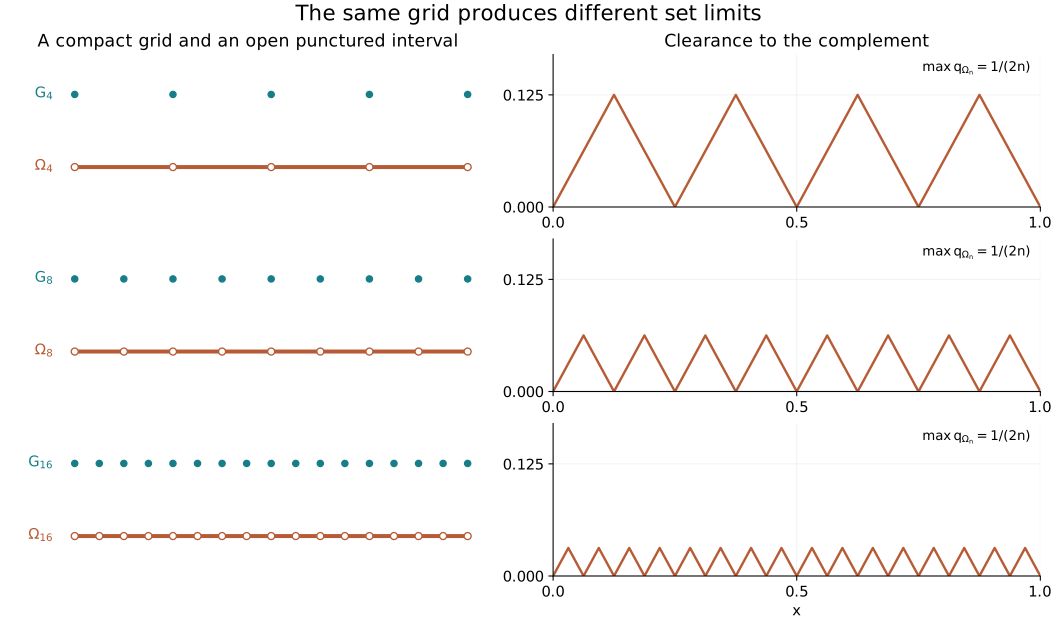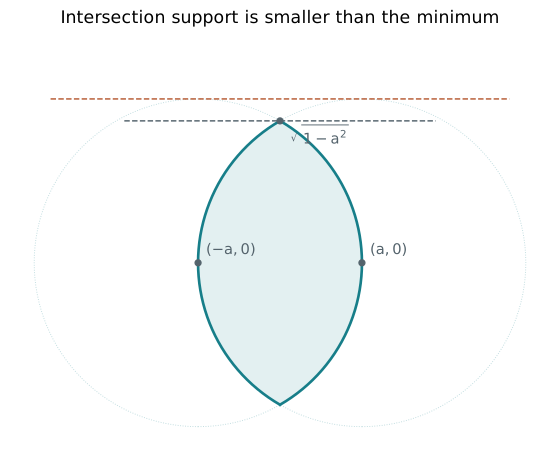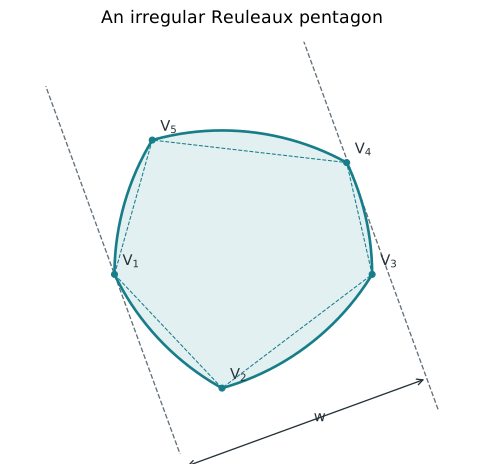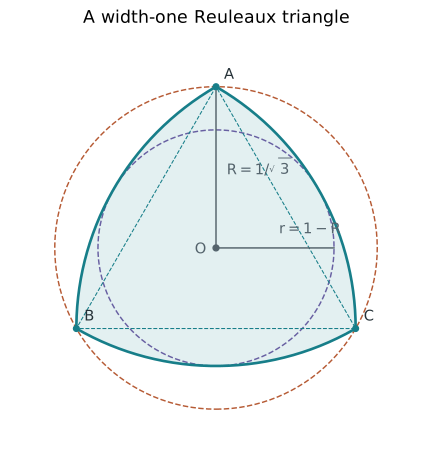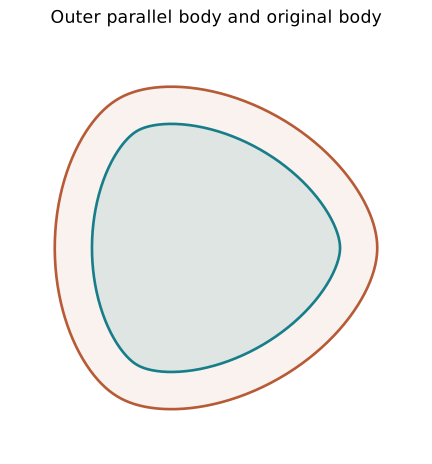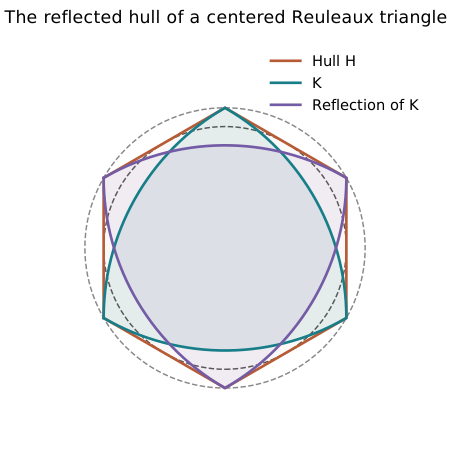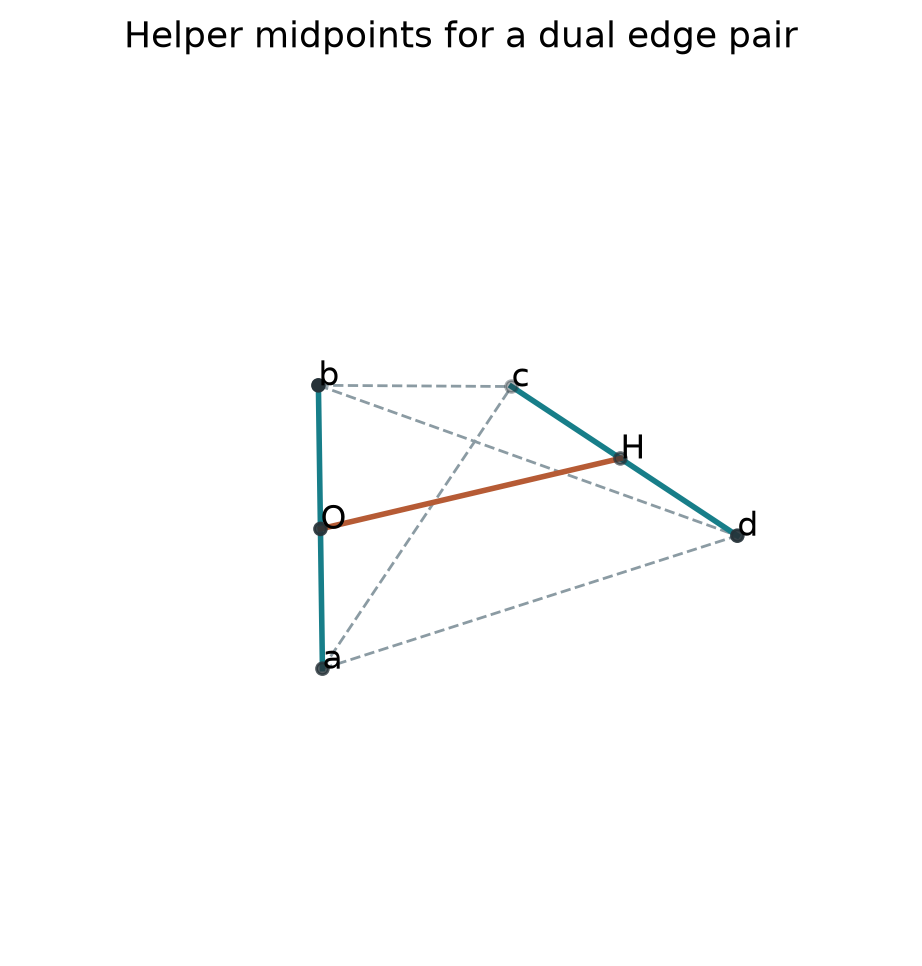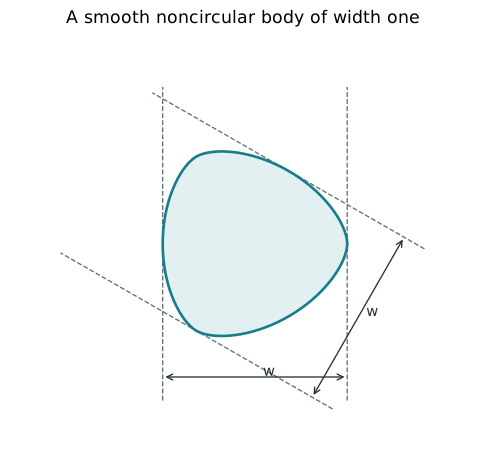
A set encoded by its distance function
For a nonempty set , define . Prove that is 1-Lipschitz, , and . For nonempty closed sets , prove Explain why distance functions cannot distinguish an open ball from its closure.
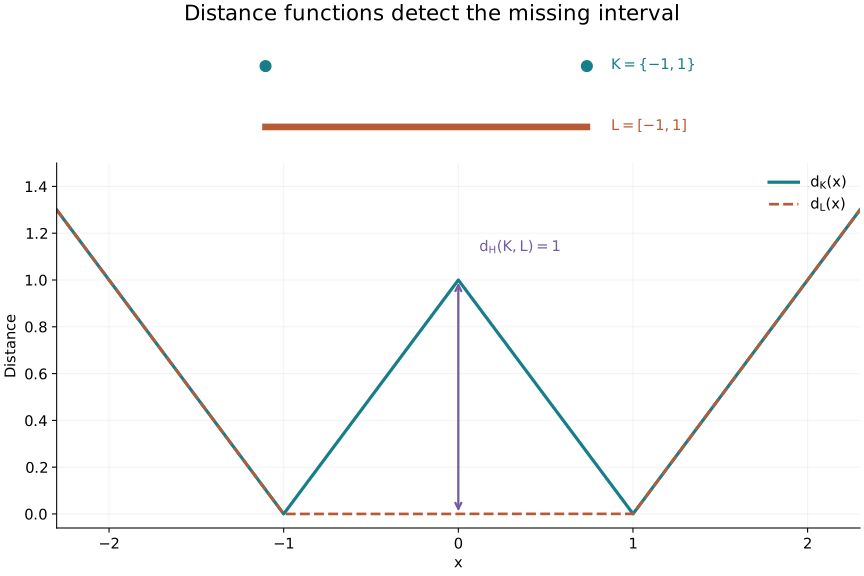
The endpoints and the filled interval have the same convex hull and support function, but different distance functions. Their Hausdorff distance is one, attained by the distance-function gap at x=0.
Apply the triangle inequality before taking the infimum. Test an inequality of distance functions on their zero sets.
For any , . Taking the infimum over gives ; reverse for the Lipschitz estimate. Taking the infimum over the closure gives the same value by continuity of . A point has zero distance precisely when points of approach it, proving the zero-set identity. Inclusion enlarges the set over which the infimum is taken, so implies . Conversely, if that inequality holds, every has , hence lies in closed . The infimum over a union is the smaller of the two infima. Finally an open ball and its closure have the same closure, so their distance functions coincide.
Checked draft. ChatGPT 6 Astra; mathematical and exposition review, 2026-10-15; human mathematical review pending
Sources
- Shape Variation and Optimization: A Geometrical Analysis (2018) — §2.2.3.1, Definition 2.2.7, p. 30; proof of Theorem 2.2.25, p. 44; English edition (2018), printed pages
Topics
distance functions · set inclusion